Pronunciation Checker Tools | 9 Compared, 6 Free, 5 That Score You
Published: ·Updated: ·22 min read
 Sho
ShoSearch for a free English pronunciation checker and you get list after list of tools. The trouble is that the things on those lists are not the same kind of tool. Some score the voice you record. Some only play a native speaker saying the word. Some just turn text you type into audio. They all end up in the same table with nothing separating them.
The conclusion first. Of the 9 tools below, 5 put a number on your own voice. The rest are for hearing a model, making a model, or turning what you said into text, and none of them score anything. That is not a criticism. They have different jobs.
There is a second thing that gets mixed into the free shelf: apps that are free for 7 days and paid after that. Of the 9, 6 have a tier you can keep using with no deadline, There is a second thing that gets mixed into the free shelf: apps that are free for 7 days and paid after that. Of the 9, 6 have a tier you can keep using with no deadline, 2 become paid once the trial ends, and 1 does not publish its prices at all., and 1 does not publish its prices at all.
Quick recommendations by purpose: If you want to see how you actually pronounced words in a real lesson rather than in a prepared sentence, use SpeakCoach. If you want a single measurement right now, use AnyToSpeech, which requires no account or installation. If you want something to use every day, try ELSA Speak. If you only want to hear the correct pronunciation of a word, use Cambridge Dictionary. The reasons are in the table and the sections below. If you want to see how you actually pronounced things inside a real lesson rather than inside a prepared sentence, SpeakCoach. If you want one measurement right now, AnyToSpeech, which needs no account and no install. If you want something to keep doing every day, ELSA Speak. If you only want the correct sound of a word, Cambridge Dictionary. The reasons are in the table and the sections below.
Key takeaways
- Tools called pronunciation checkers come in 4 kinds: ones that score you, ones that play a model, ones that make a model, and ones that turn your speech into text
- Of the 9 here, only 5 put a number on your own voice. The others score nothing
- 6 have a free tier with no deadline; 2 become paid once the trial ends
- 1 of them does not publish its prices
- If all you want is the correct sound of a word, you do not need a scoring tool. A dictionary is enough
- A score shows you where you are off right now. Raising the number is not the goal in itself
Four different kinds of tools are all called pronunciation checkers. all get called a pronunciation checker
The tools that come up in search split into 4 groups by what they actually do. Split them first and you can decide for yourself which one to open.
- Scores your voice — analyses what you said and returns a number or a mark showing where you were off
- Plays a model — lets you hear how a native speaker actually says it. No score
- Makes a model — reads out English you type and turns it into audio. No score
- Recognises only — turns what you said into text. It never says whether you were right
This split is not something invented for the sake of an argument. One text-to-speech service states in its own article that it has no automatic pronunciation scoring and no way of flagging where you went wrong, and it still ranks high when people search for a pronunciation checker. The tool is being honest. The roundups are the ones mixing things together.
Once you can see there are 4 kinds, the order follows. Hear a model so you know the correct sound. Get scored on whether you can produce it. When something needs fixing, go back to the model. Scoring on its own goes nowhere, because if you do not know the correct sound Once you can see that there are four kinds, the order becomes clear. Hear a model so you know the correct sound. Get scored on whether you can produce it. When something needs fixing, go back to the model. Scoring on its own goes nowhere, because if you do not know the correct sound, there is nothing to aim for..
Free and free trial are not the same shelf
Some of what gets listed as free is a trial with an expiry date on it. The table below uses two different labels for these: has a free tier, and paid after a trial.
BoldVoice, for example, says on its own site that the first 7 days are free, and Speak has a 7-day free trial after which it splits into Premium and Premium Plus. Both are good apps. If what you are looking for is something you can keep using for nothing, they belong on a different shelf.
One more thing, about price itself. Inside ELSA Speak's own domain, 3 different prices for the same subscription are visible at the same time. Some campaign is always running, so which one you see depends on when you open the page. Read the figure off the checkout screen on the day, not off a roundup written earlier.
If you want to use Google without installing anything, use its web-based tools.
Sometimes you only want to check a sound and you do not want another app on your phone. Google will play a word for you straight from the search box, and there is also a feature that listens to you say the word and tells you how you did. That second one is the part to watch. Google itself describes it as a limited beta experience, and it runs on language pairs, where you practise a language other than the one you already speak. There is no pairing in which an English speaker practises English, so that feature is not something you can open.
What does work without installing anything is the plain speech-to-text side. Open Google Translate, set the input language to English, say the word, and read back what it typed. That tells you whether the machine heard the word you meant, and nothing beyond that. It is a pass or a fail, not a score: it will not tell you which syllable you pressed on, and it will not tell you which sound was off. For anything finer, you need one of the tools that actually scores you.
How to choose a pronunciation checker
Settling your own conditions first is faster than comparing 9 tools. There are 4 things to decide.
- Free forever, or is paid acceptable — the free shelf has 7-day trials mixed into it, so look for an expiry date first
- What you want measured — a word, a fixed sentence, or a conversation. Tools differ in the unit they can handle
- How fine you need it — is a number enough, or do you need to know which sound was off? Some go down to the individual sound; others stop at the word
- Whether the recording is kept — if you want to listen back later, pick one that keeps it; if you do not want your voice stored, pick one that states it does not
The fourth one gets overlooked. What happens to your recorded voice is often not written anywhere on the official pages. In the table, that column is marked ※.
The 9 at a glance
| Tool | What it does | Price | What it measures | How fine the scoring is | Recording kept |
|---|---|---|---|---|---|
| SpeakCoach | Scores your voice | Free tier | Conversation | Several dimensions | Kept |
| ELSA Speak | Scores your voice | Free tier | Word, sentence, conversation | ※ | ※ |
| AnyToSpeech Pronunciation Test | Scores your voice | Free tier | Sentence | Several dimensions | Not kept |
| BoldVoice | Scores your voice | Paid after trial | Sentence, conversation | Several dimensions | Kept |
| Speak | Scores your voice | Paid after trial | Sentence, conversation | ※ | ※ |
| Cambridge Dictionary | Plays a model | Free tier | Word | No scoring | Not kept |
| YouGlish | Plays a model | ※ | Word, sentence | No scoring | Not kept |
| NaturalReader | Makes a model | Free tier | — | No scoring | Not kept |
| Google Translate | Recognises only | Free | Word, sentence | No scoring | Not kept |
Source: SpeakCoach 実装(自社) / ELSA 公式 / AnyToSpeech 公式 / BoldVoice 公式 / Speak 公式 / Cambridge Dictionary 公式 / YouGlish About / YouGlish 公式 / NaturalReader 公式 / Google 翻訳 公式
The 5 ways to assess your own voice
What changes when a score comes back is that you can see the gaps you cannot hear in yourself. While you are speaking, you have no access to how you sound to the person listening. The tools here use a machine to point out that difference for you.
SpeakCoach
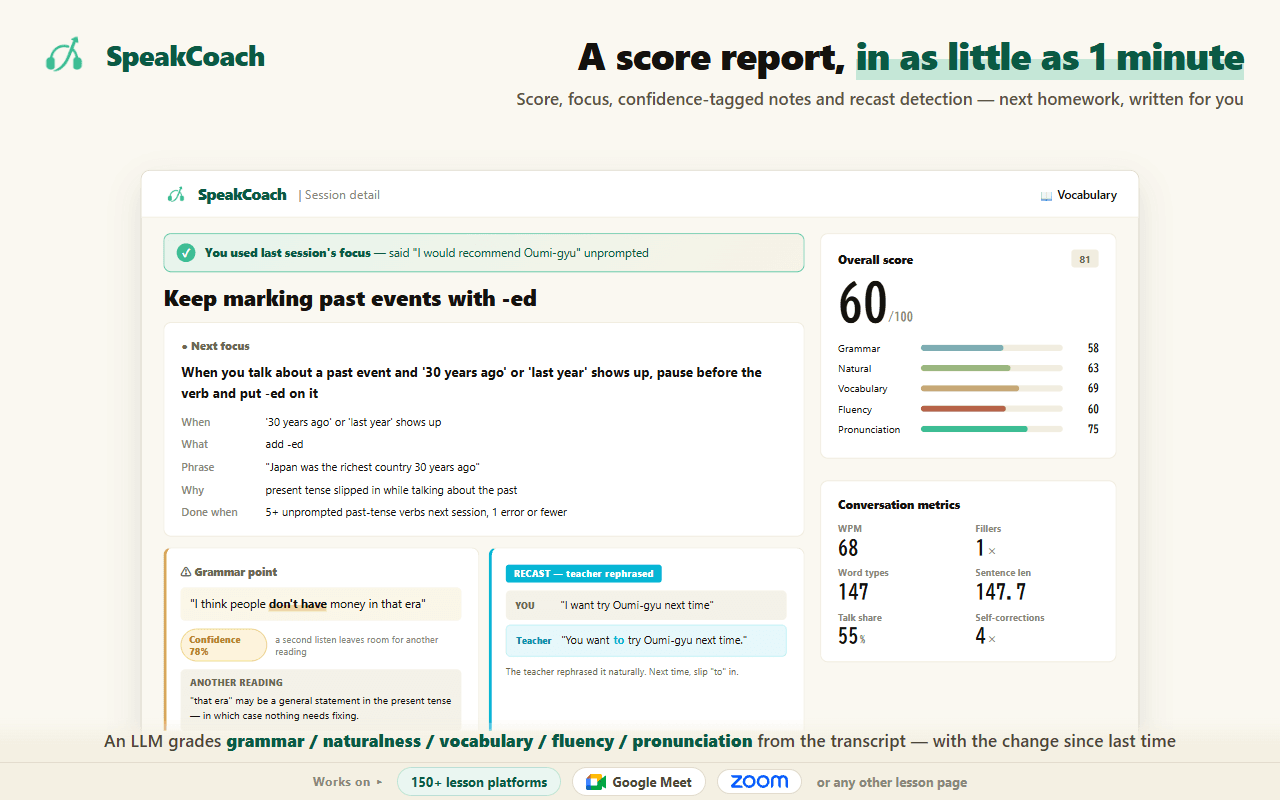
★What makes it different is that it measures how you pronounced things inside a lesson you actually took, not inside a practice sentence. The recording auto-deletes 30 days after analysis finishes (you can listen back until then). Recording needs the Chrome extension, so the lesson has to run in a desktop browser (you cannot record with a phone alone)
Open it Open it when you want to see how you spoke in a real lesson rather than in a prepared sentence. It covers the sound you make while you are still working out what to say, which reading practice never reaches. to see how you spoke in a real lesson rather than in a prepared sentence. It covers the sound you make while you are still working out what to say, which reading practice never reaches.
SpeakCoach official page
ELSA Speak
A learning app with scoring built in. The official site talks about a learning path optimised for each person and immediate personalised feedback in every lesson. There is a free tier
★Prices vary even within the official domain: as of 2026-09-30, the Japanese site (elsaspeak.com/ja/) showed ¥3,380/month, ¥11,200/year (about ¥933/month), and a ¥36,368 lifetime plan, with a "¥2,316/month" banner also shown when selecting the annual plan. A campaign is always running, so which price you see depends on when you open it
Open it Open it when you want a daily lesson rather than a one-off measurement. Because a learning path is laid out for you, you do not have to decide what to work on., rather than a one-off measurement. Because a learning path is laid out for you, you do not have to decide what to work on.
the official ELSA Speak page
AnyToSpeech Pronunciation Test
★Scores on 4 dimensions: completeness, accuracy, fluency and pronunciation quality. Read out the sentence it shows you and it returns a score out of 100 plus word-by-word feedback, and it detects errors down to the individual sound. No sign-up, and it works the moment you open it
Price: the pronunciation test itself is free and needs no account or registration; the official answer is that it is completely free. A premium tier that removes the daily limit starts at $7 a month
★It is one of the few tools that states outright that it does not keep recordings. The official wording is that audio is sent for analysis and deleted immediately, and that voice recordings are never stored. The interface covers 28 languages (confirmed 2026-09-30 from the official site's hreflang tags)
Open it when — you want one measurement right now. No account, no install: open the page, read the sentence it shows you, done. It’s useful for finding out where you currently stand.
The official AnyToSpeech Pronunciation Test page
BoldVoice
★One of the few tools whose official site names the things it scores: pronunciation, stress and clarity. It records you saying phrases and having conversations, then analyses them.
Price: the first 7 days are free. No figure appears on the front page
Open it Open it when you want to be asked to repeat yourself less often at work. Because the official site names what it scores, the numbers map onto something you can act on. to be asked to repeat yourself less often at work. Because the official site names what it scores, the numbers map onto something you can act on.
BoldVoice's official page
Speak
The official site says it returns not only pronunciation but how natural your phrasing sounds. Premium Plus generates lessons out of your own mistakes
Price: a 7-day free trial, then 2 tiers, Premium and Premium Plus. The amounts are not published
Open it Open it when you do not want to focus solely on pronunciation but also want to see whether your phrasing is natural. Feedback comes back inside a spoken exchange, which feels different from drilling words. but to see whether your phrasing is natural at the same time. Feedback comes back inside a spoken exchange, which feels different from drilling words.
Speak official page
Tools for hearing a model, and tools for making one
Scoring tools on their own are not enough. Being told that a sound is off is no help if you do not know what the correct sound is. So here are the tools for hearing a model, and for making one.
Cambridge Dictionary
★A dictionary that plays British and American English side by side, with the phonetic transcription next to them. The official site says the audio is not synthesised but recorded by real people, and that and that it covers every word from CEFR A1 to C2
Open it Open it when you want to check the correct pronunciation of a word.. The transcription is printed alongside, so you can check the sequence of sounds with your eyes as well as your ears.
Cambridge Dictionary official page
YouGlish
★Instead of a dictionary recording, it lines up real video clips of the word being said. You can filter by part of speech, by speaker gender and by person (Obama or Clinton, for example), so you can hear how it shifts with context
★The official About page says nothing at all about price and asks for donations instead. There is no interface language switcher on the About page or on the front page either (English is one of the languages you can search in)
Open it Open it when the dictionary recording does not settle it for you.. The same word changes with the speaker and the situation, so lining up several real instances gives you a sharper outline than one dictionary recording does.
YouGlish's official page
NaturalReader
★A tool that reads English you type and makes a model out of it. It does not score. Long documents and PDFs can be turned into audio as they are, so you can supply your own practice material. It runs in the browser, as a phone app, and as a Chrome extension
Price: Price: The official site states that it offers a free-forever plan and that no credit card is required. Paid plans are divided by use case (Personal, Commercial, and EDU).. Paid plans are split by use (Personal, Commercial, EDU)
Open it Open it when you want to supply your own material. to supply your own material. Coursebook English or a document you have to read at work: paste it in and it becomes audio. Playing it alternately with your own recording is an easy way to compare the two.
NaturalReader official page
The tool only recognises English.
Google Translate
★The official site only ever describes speech as an input method: The official site describes speech only as an input method—for example, by saying that users can type, speak, or write by hand, or use voice input. Nothing on the page mentions evaluating pronunciation.. Nothing on the page mentions evaluating pronunciation
★Recognised correctly does not mean pronounced correctly. Getting through is a pass or a fail, not a score
Open it Open it when you want a rough sense of whether you are getting through, using what is already on your device. a rough sense of whether you are getting through, using what is already on your device. It suits a very coarse check before you commit to a dedicated tool.
the official Google Translate page
Whether your speech turned into the right text is not a score. Recognition succeeding only means the machine could make it out. No number comes back, and neither does any indication of what was off. It works for a rough check on whether you get through, but assume it gives you nothing you can act on.
Why your first language keeps pulling the sound back, and how to fix rhythm
The first wall you hit when you try to fix your pronunciation is that you cannot hear that you are off. When English has a sound your first language does not, you learn it as the nearest sound your first language does have, and that substitute settles in as the sound of the word. Inside your own head it is correct, so there is nothing to be suspicious of until somebody tells you.
In second language research, this noticing step has long been treated as the entry point for learning. Exposure on its own does not install a form; it is only when attention lands on the form that it gets taken in.
(Author's summary) No second language form is learned without conscious noticing. For input to become intake, the learner has to direct attention to the form.
This is where a scoring tool earns its place. More than the number itself, what works is finding out that a sound you were sure you had right is off. Put the other way round: if you only let models wash over you, no noticing happens, and the sound stays exactly as it was.
Rhythm and where the stress falls
Individual consonants and vowels are the part people worry about, but what mostly decides whether you get through is Individual consonants and vowels are what people worry about, but what mostly decides whether you get through is which syllable you stress and the rhythm of the sentence as a whole. and the rhythm of the sentence as a whole. Put the stress in the wrong place and a word can be heard as a different word, even when every sound inside it is correct.
Among the tools listed here, the ones that score on several dimensions look at fluency and stress as well as at the accuracy of the sounds. Scoring high on single words and still not getting through in conversation happens because the unit being measured is a different one.
And you do not have to lose your accent. Most of the people who speak English are not native speakers, so it is simply not true that you have to sound like one to be understood. Getting to the point where the other person does not have to ask you to repeat yourself is enough.
What AI scoring is actually looking at, and where accent fits
Several of the scoring tools rest on the same design. One widely used engine is the pronunciation assessment in Azure AI Speech, and because its specification is public you can read straight off what it looks at. When a score comes back lower than you expected, this breakdown tells you where to look.
4 scores come back
| Score | What it looks at | Unit it is reported at |
|---|---|---|
| Accuracy | How closely each sound matches native pronunciation | Sound, syllable, word, whole utterance |
| Fluency | How closely the silences between words resemble a native speaker's | Whole utterance only |
| Prosody | Stress, intonation, speaking rate and rhythm. Naturalness and expressiveness | Whole utterance only |
| Completeness | The proportion of the given words that were actually pronounced | Whole utterance only |
Source: Microsoft Learn
The point is that these 4 look at different things. Every individual sound can be accurate and fluency will still drop if your pauses are unnatural. You can speak smoothly and accuracy will still drop if individual sounds have been substituted. There is no single ruler called good or bad pronunciation.
Accuracy goes all the way down to the individual sound. For hello, for instance, the expected sounds are h ɛ l oʊ, and the result can come back saying that what you produced in the second position was ə rather than ɛ.
The overall score is decided by your lowest score
This is the most misunderstood part. The overall score is not the average of the 4. The 4 are sorted from lowest to highest and then weighted differently, starting from the lowest.
So 3 scores of 90 and 1 of 50 pull the overall figure sharply toward 50. When the number will not move, the fast route is not to raise the average but to identify the single lowest one and fix only that.
Per word, the type of error comes back as well. A word scoring under 60 on accuracy is flagged as mispronounced, and the other types are omission, insertion, unexpected break, missing break and monotone. Omission and insertion only appear when you hand the tool the text you are going to read. You can identify omissions or insertions by comparing the text you were given with what you actually said.
Accent detection is a different thing from scoring
There is a well-known party trick where an AI guesses your country from your English accent. That is not pronunciation scoring. It classifies which region your speech resembles, and it says nothing about better or worse.
Pronunciation assessment measures distance from an expected sound pattern. Having an accent is not itself penalised; the relationship is that moving away from the expected sounds lowers accuracy. Erasing an accent and raising a score are not the same project. If the goal is to know which country you sound like, one visit to a detector site settles it. If the goal is to be understood, the breakdown of the score is the thing to look at.
A score comes back. A fix does not
Use a scoring tool and you almost always get a number. But why the number dropped, and what to do differently with your mouth tomorrow, are separate questions. Tools that go down to the individual sound will tell you which sound was off; how to produce that sound is something you go and find out for yourself.
And a sound that has already set does not come loose just from hearing the correct one. The idea that learners build a system of their own that stays put, and hardens if left alone, has been argued for half a century.
(Author's summary) Learners construct a language system of their own, distinct from both the target language and their first language. Parts of that system stop moving towards the target forms and stay fixed, however long study continues.
Source: Selinker (1972) Interlanguage, IRAL 10(1-4) (retrieved 2026-08-19)
An analysis pooling classroom corrective feedback reports that pushing learners to reformulate for themselves has a larger effect than supplying the correct form for them to hear. ★What that analysis compared was ways a teacher gives feedback, not machine scoring. What follows from it is only that having a chance to say it again yourself, after noticing, makes it stick. It says nothing about the effect of a score.
(Author's summary) Oral corrective feedback has a significant effect on second language acquisition, and prompts, which push learners to reformulate for themselves, had a larger effect than recasts, which supply the correct form. The analysis covered 15 studies involving a total of 827 learners.
Also, scores rise when you read the same sentence over and over. Whether what improved is your pronunciation or just your familiarity with that one sentence is not something the score can separate. 90 on the third attempt does not mean 90 on a sentence you have never seen.
Combining it with shadowing: How it improves your listening skills
Every tool so far measures a bounded piece of sound. One word, one sentence, a fixed length read out and scored. That is measuring at a point. Real conversation, on the other hand, does not stop. Words that are right on their own can collapse once they are joined up.
Shadowing fills that gap. You listen to a model and say the same thing aloud a beat behind it, copying the rhythm as a whole instead of fixing sounds one at a time. Where sounds join and become another sound, where they disappear, where the pressure falls: all of it goes in together.
Paired with a scoring tool, the roles divide. Shadowing builds the flow; scoring finds Paired with a scoring tool, the two methods serve different roles. Shadowing builds the flow; scoring identifies which sound differs from the reference; then you go back to the model for that sound alone. With only one of the two, you drift to one side: good flow with individual sounds still off, or accurate sounds that come out stiff in conversation.; then you go back to the model for that sound alone. With only one of the two you drift to one side: good flow with individual sounds still off, or accurate sounds that come out stiff in conversation.
You can supply the material yourself with a tool that makes models. Coursebook English, or the phrasing you actually use at work: have it read aloud and it becomes shadowing material. Working on sentences you genuinely have to say lasts longer than hunting for published material.
The sounds you can produce and the sounds you can hear sit close together
★Which of the two changes first is not something that can be shown here; there is no measurement to that depth on hand. Still, people who practise pronunciation often feel their listening shift before their speaking does. A distinction you cannot produce is a distinction you struggle to hear. ★Which of the two changes first is not something that can be shown here; there is no measurement at that level available. Still, people who practise pronunciation often feel their listening shift before their speaking does. A distinction you cannot produce is a distinction you struggle to hear. Once you can produce the two distinctly, they start catching your ear when somebody else says them., they start catching your ear when somebody else says them.
This is another reason to use a scoring tool. Raising the number is not the point. Finding out that you had been treating two sounds as one is. From the moment you know, the resolution of your listening starts to change.
So if a few days of practice have not changed how you sound, there is no reason to stop. Your ears move first and your mouth follows. If you want a read on progress, whether the other person's words catch your attention more than they used to shows up sooner than a score does.
How much is enough per day?
Coming back to it briefly, many times, with gaps in between, stays with you better than setting aside one long block. 5 minutes is fine. Short, daily sessions work better for this than one long session a week.
As a routine, 3 steps are easy to hold on to: hear a model so you know the correct sound; record the same sentence and have it scored; go back to the model for only the sounds it flagged. Chasing the number from the second step does less than increasing how often you do the third.
And once you can score well on words and short sentences, check the sound of yourself in a real speaking situation. Reading a prepared sentence carefully and speaking while figuring out what to say do not involve the same pronunciation skills.
If you want this in your own lessons — SpeakCoach
Summary — which one to open, by purpose
- See your pronunciation inside real lessons → SpeakCoach (measures the sound inside conversation, and the recording stays)
- One measurement right now → AnyToSpeech (no account, no install; scores on 4 dimensions, and states that recordings are not stored)
- Something to keep doing every day → ELSA Speak (a learning path means you do not have to decide what to work on)
- Be asked to repeat yourself less often at work → BoldVoice (the official site names 3 things it scores: pronunciation, stress, clarity. Paid after the 7-day trial)
- See whether your phrasing is natural too → Speak (paid after the 7-day trial)
- Check the correct sound of a single word → Cambridge Dictionary (British and American, plus the transcription)
- Hear how it is pronounced in context → YouGlish (finds and lines up real video clips)
- Turn your own material into audio → NaturalReader (Free forever plan)
- A rough check on getting through, with what you already have → Google Translate (there is no scoring)
Worth remembering
- 4 kinds of tool come up under pronunciation checker: scores you, plays a model, makes a model, recognises only
- Of the 9 here, 5 score your own voice
- 4 things to settle before choosing: free with or without an expiry, the unit measured (word, sentence, conversation), how fine the scoring is, whether the recording is kept
- The free shelf has 7-day trials mixed into it. Look for an expiry date first
- Prices move with campaigns. Take the figure off the official site, not off a roundup
- More than the number, what works is finding out that a sound you were sure of is off
- Which syllable you press on and the rhythm of the sentence decide whether you get through, more than individual sounds do
- Scores rise when you repeat the same sentence. The score cannot tell you whether that was pronunciation or familiarity
- Come back briefly and often, with gaps. Once words score well, check how you sound in a real speaking situation
Sources
Every source below was checked by opening the page itself. Pages change, so we note the date each one was retrieved.
Source: SpeakCoach 実装(自社) (retrieved 2026-08-24) / ELSA Speak 公式(日本語) (retrieved 2026-08-24) / AnyToSpeech 公式「無料英語発音テスト」 (retrieved 2026-08-24) / BoldVoice 公式(American Accent Training App) (retrieved 2026-08-24) / Speak 公式 (retrieved 2026-08-24) / Cambridge Dictionary 公式 Pronunciation (retrieved 2026-08-24) / YouGlish 公式 About (retrieved 2026-08-24) / YouGlish 公式 (retrieved 2026-08-24) / NaturalReader 公式(AI Text to Speech) (retrieved 2026-08-24) / Google 翻訳 公式(About) (retrieved 2026-08-24) / Schmidt (1990) The Role of Consciousness in Second Language Learning, Applied Linguistics 11(2) (retrieved 2026-08-19) / Microsoft Learn「発音評価を使用する」(Azure AI Speech) (retrieved 2026-08-31) / Selinker (1972) Interlanguage, IRAL 10(1-4) (retrieved 2026-08-19) / Lyster & Saito (2010) Oral Feedback in Classroom SLA: A Meta-Analysis, Studies in Second Language Acquisition 32(2) (retrieved 2026-08-19)
Frequently asked questions
- How far can I trust AI pronunciation scoring?
- How far a sound sits from the reference comes back fairly stably. What not to trust is the absolute value of the number. The same sound moves by several points depending on microphone position, background noise and how fast you read. Tools also use different references, so lining a score from one up against a score from another means nothing. The reliable way to use it is to use the same tool and microphone, read the same sentence a few times, and watch how the score changes.
- I keep getting around 60% however many times I try, and it will not go up.
- First, not going up and not getting through are different things. Most tools measure closeness to a reference speaker, so pronunciation that gets through perfectly well still does not reach full marks. Beyond that, what works when the number is stuck is not reading the whole thing again, but picking the single lowest sound in the result and drilling only that one. If your tool reports down to the individual sound, you can see it. If it does not, moving to one that does will be faster.
- What kind of sentence should I read to measure my pronunciation level?
- Use the same sentence every time. Change the sentence and you change the difficulty, so you can no longer tell whether the improvement was due to your pronunciation or the text. 10 to 15 words, on something you would plausibly say in an ordinary conversation, works well. There is no need for a famous test sentence. In fact, the more you practise, the better you get at that one sentence and nothing else, so keep the sentence you measure with separate from the sentences you practise on.
- Can free tools alone fix my pronunciation?
- Getting as far as noticing where you are off is entirely possible for free. Tools that report down to the individual sound exist at no cost, so you can find out which sound is the problem. The hard part comes after that: how to produce the sound you noticed is something you go and find out yourself. And since most of these measure you reading a given word or a short sentence, whether it holds up inside a conversation is something to check separately.
- Should I use my phone or my computer?
- Either is fine, but microphone position affects the result. A laptop's built-in microphone is far from your mouth and picks up the room, so scores can come out below your actual level. An earphone microphone is more stable. When you are comparing inside one tool, use the same microphone every time.
- Should I practise American or British English?
- Pick one and do not mix them halfway; it is easier that way. Scoring tools generally take one or the other as their reference, so pronouncing against the other one costs you points. Cambridge Dictionary plays both side by side, so listening to the two before you decide is a good way in.
- What happens to the recording of my voice?
- It varies by tool, and it is a detail that often is not stated officially at all. That is why some cells in the table are marked ※. Some tools do state it clearly: AnyToSpeech publishes that audio is sent for analysis and deleted immediately, and that voice recordings are never stored. If it matters to you, that tool's privacy policy is the place to check.
- How dependable are the numbers?
- They rise when you repeat the same sentence, so how you read the movement matters more than the number itself. A score on a sentence you have never seen and a score after 3 reads are two different things. Also, what the machine measures is closeness to a reference sound, not whether the person in front of you understands. Plenty of accented English gets through perfectly well, so do not read a low score as not getting through.
- Do I have to sound exactly like a native speaker?
- No. Most of the people using English are not native speakers, so it is not the case that you have to sound like one to be understood. As a target, getting to where the other person does not have to ask you to repeat yourself is enough. The one thing worth checking is where the stress falls, because misplaced stress can make a word sound like a different word.
- What are the free ways to check English pronunciation?
- Choosing from the tools that have a free tier with no deadline is the safe route. What gets listed as free elsewhere has time-limited trials mixed into it, which is why the table above uses two separate labels: has a free tier, and paid after a trial.
- Is there a site that measures how strong my accent is?
- Nothing on this shelf puts a percentage on an accent. The nearest thing is scoring your vowels and consonants sound by sound and showing you the weak ones. An accent is a collection of places where a sound has drifted towards the nearest sound in your first language, so the per-sound scores are what tell you where to work. If you were hoping for a country guess, that is a different kind of tool with a different purpose.