How to Review English Lessons: Re-reading Notes Fails
Published: ·Updated: ·8 min read
 Sho
ShoYou book the lesson, you talk for 25 minutes, you write down what the teacher corrected. Next week you do it again. Six months later the same words still will not come out of your mouth. The lessons are not the problem, and neither is your memory. The problem is what happens between the lessons.
Most advice tells you to take better notes. That is the wrong end of it. What decides whether a phrase becomes yours is not how neatly you wrote it down — it is whether you ever had to pull it back out of your head without looking.
Key takeaways
- Re-reading your notes is the weakest part of a review. What makes a phrase yours is having to pull it out of your head without looking.
- Write down three things and nothing else: what you could not say, what you did not understand, and a mistake you have been corrected on before.
- Keep the answer side hidden. Two columns with the right side covered turns every review into recall instead of reading.
- Space your reviews out. A short gap and a long gap look the same on an immediate test, but the longer gap wins once time passes.
- When the same mistake comes back, add the date to the old line instead of writing a new one. Three dates means it is a habit, not a slip.
- Many services now keep a recording or a transcript of the lesson by default. Check what yours keeps before you build your own system.
Why re-reading your notes does not work
There is an experiment on foreign-language vocabulary that separates the two things people call "review". After learners had already got an item right once, one group kept re-studying it and another group kept being tested on it. Re-studying produced no benefit on the delayed test. Repeated testing produced a large one.
(paraphrased) Repeated studying after learning had no effect on delayed recall, but repeated testing produced a large positive effect. In addition, students’ predictions of their own performance were unrelated to actual performance.
The second sentence is the one that matters for you. The learners could not tell how much they actually knew. Reading your notes and feeling "yes, I know this" is not evidence that you know it. The only thing that tests knowing is trying to produce it.
So the format of your notes is decided for you. Write them so that later you can be tested by them: the cue on one side, the English on the other, and the English hidden. A page with the English and your own language side by side, both visible, is exactly the version that did not work.
Write down three things and nothing else
If you try to keep everything from a lesson, you will stop within two weeks. Keep only what you can act on before the next lesson. Three lines is a complete entry. Some days one line is a complete entry.
1. What you could not say (most important)
The moments you went silent, or said something clumsy because the real sentence would not come. Write the idea in your own language during the lesson. Afterwards look it up and commit to one English version. Not three alternatives — one. Only one of them is going to come out of your mouth next time, so choose it now.
This item comes first because it is the one that leaves no trace. A phrase your teacher gave you feels memorable. A phrase you failed to produce leaves only the feeling of failing, and next week you stop in exactly the same place. Noticing the gap between what you said and what you meant is where learning starts.
(paraphrased) What learners notice in input becomes intake.
2. Words that did not get through
Anywhere the teacher asked you to repeat yourself. Write the single word, not the whole sentence. Usually one or two words carried the failure, and once you have isolated them you know exactly what to practise. Written as a sentence, you cannot tell what to fix.
If the sounds seem right and the word still does not get through, check where the stress falls. Note the fix on the same line, not just the word: "comfortable — three syllables, stress on the first" is useful next week. "comfortable" alone is not.
3. The mistake you made last time too
Mistakes that vary are fixed on the spot and forgotten. The ones that harden are the ones that come out in the same shape again and again — a dropped third-person s, a missing article, present tense for something that happened yesterday. Most people have two or three, not twenty.
An error that has settled in does not come off just because you hear the correct version. That is why this item gets a date every time it reappears rather than a fresh line: you are tracking a pattern, not collecting incidents.
The template (keep the right side hidden)
Each of the three items goes into a two-column layout where the right side can be covered. On paper, draw a line down the middle. In a spreadsheet, hide the right column. In Notion, use a two-column table and collapse it. Here is what a real page looks like.
| Item | Left (the cue — this is all you look at) | Right (hidden) | Marks |
|---|---|---|---|
| 1. Could not say | been meaning to ask (about that) | I have been meaning to ask you about that. | 8/19 |
| 1. Could not say | traffic completely stopped | The traffic was at a standstill. | 8/19 |
| 2. Not understood | allergy | Stress the first syllable, keep it short | 8/19 x2 |
| 3. Same mistake | He ___ to submit it by Friday. | has (I keep saying have — third person) | 8/12, 8/16, 8/19 — 3rd time |
| 3. Same mistake | I ___ a friend at the station yesterday. | met (I keep saying meet) | 8/15, 8/19 |
Source: Karpicke & Roediger 2008 / Selinker 1972
The marks column is the part that does the work. When an item in group 3 has collected three dates, that is your signal to make it the theme of your next lesson. (Three is not a research threshold — it is simply a number that is easy to stick to.) Items in groups 1 and 2 get crossed out on the day you finally say them.
Do not make it neat. If you can read it, it is good enough. If you have time to rewrite your notes, you have time to recall them once instead, and recalling is what leaves something behind.
When to go back — space it out, and recall
The spacing has research behind it. A meta-analysis of 48 experiments with 3,411 participants in second-language learning found medium-to-large effects for spaced practice. It also found that short and long gaps look equally good on an immediate test, but the longer gap wins once time has passed.
| When | What you do | Time |
|---|---|---|
| Right after the lesson | Write the three items. Look up group 1 and commit to one version | 5 min |
| Next day | Cover the right side. Say each one out loud. Cross out the ones you got | 3 min |
| 3 days later | Same again. Only the ones you missed are left | 3 min |
| 1 week later | Say what remains. Anything in group 3 with three dates becomes your next lesson topic | 5 min |
That is about sixteen minutes a week. Do not try to schedule a separate review session — you will not keep it. Attach it to something you already do: open last week’s page before you open the next lesson.
One rule while you do it. Looking at the right side and thinking "ah, of course" is re-reading. Say it out loud first, even badly, even if nothing comes. The attempt is the part that works.
What to do during the lesson (do not take notes)
While you are writing, you are not talking. Three minutes of note-taking in a 25-minute lesson is three minutes taken out of your speaking time, and speaking time is the thing you are paying for. Do these two things instead — they are the only ones you cannot do afterwards.
First, ask your teacher to type it. A phrase you only heard is a phrase you will reconstruct wrongly later. "Could you type that in the chat box?" takes two seconds and most teachers will do it immediately. Copy it into your notes after the lesson, and nothing is lost in transcription.
Second, ask why. "Why is that better than what I said?" gets you further than being handed the corrected version. A meta-analysis of oral feedback in classrooms found that prompting the learner to self-correct, or explaining the rule, outperformed simply recasting the sentence correctly. Errors that have already settled in are the ones least likely to shift from hearing the right version.
If your lessons are recorded, stop copying things down
This is the part that changed recently. Lessons used to be gone the moment they ended unless you recorded them yourself. Now many providers keep the audio, the video or a transcript as a built-in feature. Check what your provider keeps before you write another word down by hand.Which tool to run that recording through is covered in a separate article.
What is kept, and for how long, differs by provider. A week is enough if you review weekly; it is not enough if you review at the end of the month. It is usually in their help pages or FAQ — worth checking once. If nothing is kept on their side, you can record it on your own side with a browser extension.
Whether you may record it yourself is a matter of the terms of service. Some providers offer official recording; some prohibit learners from recording. Read your provider’s terms before you start. Using a feature they built, within their terms, is fine.
If you still cannot keep it up (three causes, three fixes)
There are usually three reasons, and each has its own fix.
- You are writing too much — go back to three items. One line each, three lines a day is plenty
- You never open it again — do not schedule review. Open last week’s page before you open the next lesson
- You cannot feel any progress — count the crossed-out lines in group 1. Twenty in a month means twenty phrases you can now say
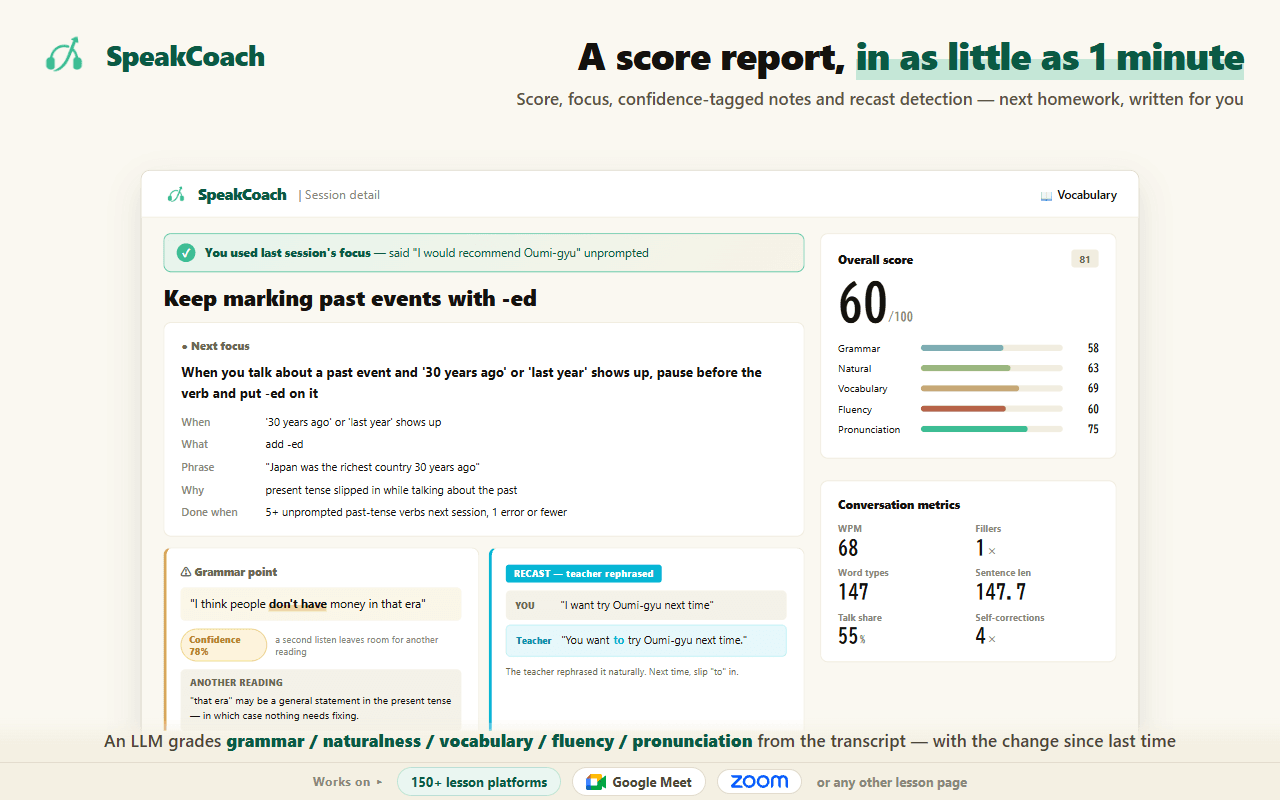
If you want this done for you — SpeakCoach
In short — what to do starting with your next lesson
- Write three things only — what you could not say / words that did not get through / the mistake you repeat
- Write it so the right side can be hidden. Recall it out loud before you look
- Go back the next day, 3 days later, 1 week later. Left side only. About sixteen minutes a week
- When an item in group 3 has three dates, that is the thing to bring to your next lesson
- Do not take notes during the lesson. Ask "Could you type that in the chat box?" and "Why is that better than what I said?"
- Check whether your provider keeps a recording or transcript before you copy anything by hand
- Do not make it neat. Rewriting your notes is time you could spend recalling them once
Sources
Every source below was checked by opening the page itself. Pages change, so we note the date each one was retrieved.
Source: Karpicke & Roediger (2008) The Critical Importance of Retrieval for Learning, Science 319 (retrieved 2026-08-19) / Schmidt (1990) The Role of Consciousness in Second Language Learning, Applied Linguistics 11(2) (retrieved 2026-08-19) / Selinker (1972) Interlanguage, IRAL 10(1-4) (retrieved 2026-08-19) / Kim & Webb (2022) The Effects of Spaced Practice on Second Language Learning: A Meta-Analysis, Language Learning (retrieved 2026-08-19) / Lyster & Saito (2010) Oral Feedback in Classroom SLA: A Meta-Analysis, Studies in Second Language Acquisition 32(2) (retrieved 2026-08-19)
Frequently asked questions
- Paper or an app — which is better?
- Either, as long as the answer side can be hidden. On paper, draw a line down the middle and cover the right with your hand or a sticky note. Digitally, a two-column sheet in Google Sheets or Excel with the right column hidden, or a two-column table in Notion inside a toggle. The real criterion is whether you can open it right after the lesson. One thing to know in advance: after about three months you will start asking "where did I write that phrase?", and that is when being able to search saves you.
- Should I take notes during the lesson?
- Better not to. Every minute you spend writing is a minute you are not speaking. Instead, ask the teacher to put corrections in the chat box, and copy them afterwards — you also avoid mishearing them. If your provider keeps a recording or transcript, there is even less reason to write during the lesson.
- If I have a recording or transcript, do I still need notes?
- Yes, but for a different reason. A transcript is a record; notes are a filter. The value is in deciding which three things out of a 25-minute lesson are worth carrying into next week — and a full transcript does not do that for you. What the recording removes is the copying, not the choosing. There are tools that do the choosing for you.
- Does it lose its value if I skip days?
- No — you do not need to do it every time. Trying to fill in the days you missed is what makes people stop. Three lines is fine, and skipping a day is fine. There is exactly one thing worth doing every time: open last week’s page before you open the next lesson.
- How much preparation should I do before a lesson?
- Less than you think, and of a specific kind. Do not rehearse whole sentences you plan to say. Instead, look at the item in group 3 with the most dates against it and decide to use that structure at least twice during the lesson. Preparation that gives you something to attempt is useful; preparation that gives you a script to recite is not.