Do Online English Lessons Work? | Hours and Plateaus
Published: ·Updated: ·19 min read
 Sho
ShoYou take a lesson every day. You have kept it up for six months, maybe a year. And still, what you are able to say does not feel different from last year. This article is written for people in that state.
The conclusion first. There is a published figure for how long it takes, and it comes from an examining body rather than from a school or someone’s personal account. Measured against it, most people are still short of the hours. But piling up hours does not always get you through, because there is a stretch where adding time stops working. This article covers those two things in that order.
This article will not tell you to take more lessons, or to switch to a different service. It is only about what to change before and after the lessons you already take.
Key takeaways
- Moving from CEFR B1 to B2 works out to 100–250 hours from the published table. In 25-minute lessons that is 240–600 lessons, which is one to two years even if you take one every day.
- Those hours count "lessons and supervised study". Self-study outside lessons, and time spent around English, are not in them. Counting things that are not included makes you read your own position as further along than it is.
- You can stall even when the hours are there. A wrong form can become the one that comes out first, and once it settles, simply speaking more does not undo it.
- Whether you are stalled is not something the feeling of progress tells you. "How many times has this same mistake come up" tells you. If you are not counting, you have nothing to judge with.
- Three things get you out: noticing what you could not say, asking your teacher to correct you differently, and deliberately using something slightly above what you can already do.
- Before adding lessons, change what happens around them. For the same hours, recall-shaped review with spacing leaves more behind.
There is a published figure for how long it takes
"How long until it works" is the question people searching this most often ask. The answers differ from article to article: two weeks, one month, three months, three to six months, a year. Most of them cite nothing.
A public figure does exist. Cambridge English, which runs English qualifications, publishes the study hours it takes to reach each CEFR level. The numbers are cumulative from a complete beginner.
| Level | Approximate hours (cumulative) | What you can do at that level |
|---|---|---|
| A1 | 90–100 hours | Greetings and very short exchanges |
| A2 | 180–200 hours | Short sentences about familiar things |
| B1 | 350–400 hours | Can keep a familiar topic going, with hesitation |
| B2 | 500–600 hours | Can explain your own view and give reasons |
| C1 | 700–800 hours | Can handle complex topics without rephrasing |
| C2 | 1,000–1,200 hours | Close to a native speaker in use |
Source: Cambridge English
The page states plainly that "these figures are intended as a guideline only". It also says the time you need changes with your learning background, the intensity of your study, your age, and how much you are exposed to English outside lesson times. So the table is a ruler for checking whether you are moving toward it, not a quota to hit.
What most people taking online lessons care about is the stretch from B1 to B2. From the table, B1 sits at 350–400 hours and B2 at 500–600, so the gap is 100–250 hours. Converted into 25-minute lessons, that is 240–600 lessons. ★That conversion is ours, not something Cambridge says.
One lesson a day puts 240 lessons at about eight months and 600 at about one year and eight months. Three times a week takes more than twice as long. "Six months and nothing has changed" is, against this figure, still partway.
Three times a week is more realistic for many people. At 25 minutes, three times a week, a full year comes to 65 hours. With B1 to B2 at 100–250 hours, a year does not even reach halfway. Concluding "maybe this is not for me" at that point is early.
Does that make the articles saying "three months" wrong? No, they are pointing at something else. What changes in three months is how used to listening you are, how much resistance you feel before speaking, how fast you react to a teacher’s question. Those genuinely move early. Moving up a level means the range of sentence patterns you can use has grown and your accuracy has come with it. The first is weeks to months; the second is hundreds of hours. Both live inside the same word.
Separating the two makes your own position easier to read. Feeling less resistance while feeling no real progress is not a contradiction. You have reached the first and are still partway through the second.
That is the time side of it. But hours alone do not guarantee the climb. There are two conditions under which the table stops applying, and that is the next section.
What those hours actually count (get this wrong and you are out by double)
The figure is published as guided learning hours. The official explanation defines it as lessons and supervised study. Separately from that, it lists "the amount of study and exposure outside of lesson times" as one of the things that changes how long you need.
So the English you listen to outside lessons, the podcast on your commute, the drama you watch, are not inside the hours in that table. They are treated as a separate factor. Mixing them in makes you read your own position as further along than it is.
| What you are doing | Inside the hours? | Why |
|---|---|---|
| A 25-minute lesson with a teacher | Inside | The lesson itself |
| Preparing and reviewing with the course material | Inside | Counts as supervised study |
| An English podcast on your commute | Not inside | Classified separately, as exposure outside lessons |
| Watching a drama with subtitles | Not inside | Same as above |
| Reading an article written in English | Not inside | Same as above |
Source: Cambridge English
Two things break this reading. One is that you may not be at B1 in the first place; the table describes moves between levels, so a different starting point changes the hours. The other is that, depending on how you take them, the 25 minutes may not all be supervised study. A session spent on how your week went, one where the teacher does most of the talking, one you got through using only phrases you already had — the time accumulates, but the substance does not.
This is what "feeling like you have taken a lesson" really is. The number of lessons stays on your calendar and is easy to count; progress is hard to count. Look only at what is easy to count and the sense of moving grows first.
What changes after 1, 3 and 6 months of keeping it up
Here is what keeping it up looks like, period by period. The months are rough guides and shift with how many lessons you take and how you take them.
In an example of two people new to English conversation (a second-year junior high school student and a 24-year-old man) who took lessons almost every day, described in the one-year test article from Mitsukaru Eikaiwa, they managed simple exchanges after about one month; after about three months they followed everyday topics for the most part; after about six months everyday conversation ran smoothly; and after about a year they could discuss current affairs such as the news. The source itself says results vary widely by person and treats them as a rough reference only.
Treat the periods as a guide only. A stretch where progress seems to stall is not unusual in itself, and how to handle it is the same as in the next section (when the hours are there and nothing changes).
When the hours are there and nothing changes, what is happening
It does happen that you pass the figure and still feel no different. Second language research has long described a learner’s language stopping its development and settling with wrong forms in place; it is called fossilization. The paper that first used the term wrote that only a small share of learners reach the level of a native speaker and most stop somewhere.
What "most stop" points at is whether you reach the level of a native speaker. It is not a figure about which CEFR level you stop at. That said, the intermediate range is a common place to stop, for a simple reason: at intermediate, wrong still gets understood.
A missing article, a dropped third-person s, a tense that slides — the other person still understands you. Because you are understood, no need to change how you say it ever appears. And after a few hundred repetitions, that form is the one that reaches your mouth first.
As skill learning this is a normal process. Moving from knowing something as knowledge to using it without thinking is called automatization, and speaking fluently requires it. The problem is that automatization happens to wrong forms exactly as readily as to right ones. Once a wrong form is automatic, it is hard to correct later.
And a form that has settled does not come loose just from hearing the correct version. A meta-analysis comparing types of correction in the classroom found larger effects for asking the learner to say it again, or explaining in words why it is different, than for a teacher quietly recasting it into the right form.
This is why more lessons do not change things. Most teachers recast quietly so as not to break the flow of the conversation. As conversation it is natural, but it is the weakest way to strip off a settled form. Doubling the number of lessons only doubles the weakest way.
There is a second reason progress gets hard to see. Speaking is usually looked at not as one line but as three: fluency, accuracy and complexity. They do not grow at the same rate. Keep taking lessons and fluency moves first — you stall less often, your silences get shorter. Accuracy and complexity, meanwhile, stop easily unless you work on them deliberately.
That asymmetry is what makes the experience confusing. While fluency is rising you feel you are getting able to speak; the moment it plateaus it looks like you suddenly stopped improving. Nothing stopped suddenly. The one that had been rising hit its ceiling first, and the two that were never moving came into view.
So it is worth looking at which of the three is moving and which is not. If you stall less often, fluency is moving. On top of that, if the number of corrections has not fallen, accuracy is stuck. If the sentence patterns you use are the same as six months ago, complexity is stuck. Do not try to raise all three at once; pick the one that is stuck.
Check whether you are in that state with records, not with how it feels
Judging by the feeling of progress is hard, and that is something research says too. In a learning experiment, learners’ own predictions of how much they had retained barely corresponded to their actual results.
What you can use instead is records. The items below are written so you can check them against your own lesson records. This is not a list saying that people it applies to are taking lessons badly. Use it to decide which of the steps in the next section to start from.
- In your last five lessons, did you write down even one thing your teacher corrected? If not, there is no way to know how many times the same mistake has come up.
- Are you counting how many times the same mistake has been pointed out? Up to the second time it is chance; three in a row is a habit.
- In the last five lessons, how many expressions did you use for the first time? If it is zero, you are running the conversation on what you already had.
- Do you remember where you went silent during a lesson? What you could not say leaves little trace, so it disappears unless you pick it up on purpose.
- Does your teacher ever push you with "tell me more" or "say that another way"? If not, your turns look complete from the outside, so nothing is pushing you upward.
- Do you say the corrected version out loud yourself within the same lesson? If you only hear it, the corrected form has not entered what you actually use.
If you cannot answer the first two, start by keeping records. What to write is settled, and three things are enough.
There is one detail in how you keep them that makes the whole thing pointless if you get it wrong: do not break the record up one page per lesson. Split by date and the same mistake scatters across pages, and you lose the count. Stack the same item in one place, and when it comes up a second time, add the date to the existing line instead of writing a new one.
Do that and within about three months your habits narrow down to two or three. What comes up is fairly settled per person: a dropped third-person s, a missing article, present tense for a past event. Once it narrows, make only that the theme of the next lesson. Do not try to fix everything at once. One is what you can hold in mind during a single lesson.
How to take lessons differently — only three things change
From here on, only things you can do without adding lessons. In other words, changing how you take them. There are three, and the order matters: if the first is not in place, the second and third spin. Other things get recommended as effective ways to take a lesson, but narrowed to the goal of stripping off fossilized forms, it converges on these three.
① Notice what you could not say
Acquisition starts where you notice — that is a line often cited in second language acquisition. What a learner notices in the input is what becomes intake. Put the other way round, what you do not notice passes through however many times you are bathed in it.
In practice: hold on to one place where you went silent during the lesson, and look it up afterwards. Write what you wanted to say in your own language, as it is, and later fit exactly one English expression to it. Do not line up several ways of saying it. Only one reaches your mouth next time, so deciding on one makes it usable.
What you could not say matters more than what the teacher corrected. Corrections stay with you; what you could not say leaves only the sensation of not having said it, and you stop at the same place next time.
② Ask for a different kind of correction
Being asked to say it again, or having the difference explained in words, has a larger effect than a quiet recast — that was the meta-analysis in the earlier section. You can change this by asking your teacher. One sentence at the start of the lesson is enough.
| When | What to say | What changes |
|---|---|---|
| At the start of the lesson | Could you stop me when I make a mistake, and ask me to say it again myself? | Shifts from hearing a recast to saying it again yourself |
| Mid-conversation | Why is that better than what I said? | Puts the reason into words. Knowing the reason lets you apply it next time |
| After being corrected | Let me say that again. | Say it out loud once more on the spot. Do not end at hearing it |
Source: Lyster & Saito 2010
All three are short. You do not need to say them every time; pass on the first one at the start and the teacher will follow. You may worry about the conversation stopping, but the place where it stops is exactly the place you can fix right now.
③ Use something slightly above what you can already do
Run the conversation only inside what you can already say and you reinforce the current shape. Use something deliberately a step up and it gets tested, and what is missing comes into view.
It lasts if you decide the method in advance: go in with exactly three expressions you intend to use in the next lesson, chosen from last time’s notes. Afterwards mark each as used or not. The ones marked not carry over.
There is no evidence behind the number three. It is chosen for being sustainable. At five, carrying them in becomes the burden itself, and before long you stop.
What to add outside the lesson — vocabulary, grammar, instant translation, shadowing
So far this has been about how you take lessons. Adding study outside the lesson fills gaps that lessons alone do not. If you are unsure what to add, pick from the list below the one closest to the way you are stuck right now.
- Vocabulary. If you know what you want to say but the words do not come, start here. Rather than working through a word list from the top, pick up only the words you could not say in the lesson; they are tied to the situations where you will actually use them.
- Grammar. If articles or tenses fall apart, it is worth going back over the basics in one book. There is little new to learn; often you already know the rule and simply do not recall it at the moment of use.
- Instant translation. Look at a sentence in your own language and repeat it until the English comes out without thinking. The aim is to cut the time you spend thinking in your own language and converting during a lesson, and a few minutes before the lesson is enough.
- Shadowing. Listen to audio and repeat what you hear a moment behind it. It helps both how fast you can follow speech and your pronunciation and intonation. In a lesson you hear the teacher’s pronunciation once; with shadowing you can replay the same audio as often as you like.
- Retelling the same content to different listeners. A known format is to tell the same story in four minutes, then three, then two, each time to a different listener. Telling the same teacher the same story twice in an online lesson is awkward, but on your own it works with self-talk or a recording. Reports say speaking speed rises and hesitations fall.
You do not have to narrow it to one, but starting all of them at once will not last. Look at the record of “how many times has this same mistake come up” from the earlier section, and add only the kind of study that matches what shows up most, for five minutes around the lesson.
Every day or once a week
Many people wonder whether they must take lessons every day, but the axis to compare is not the count itself; it is cramming versus spreading. Even for the same total time, a meta-analysis pooling many experiments on second language learning shows that spreading practice across days lasts longer than packing it into one day.
That does not mean it is pointless unless you go every day. If keeping it up is the hard part, reducing the frequency and fixing it comes first. Holding a frequency you can sustain adds up to more hours in the month than aiming for every day at a frequency you cannot. The reasons keeping it up is hard, and what to do about them, are covered in a separate article.
Sticking to the frequency you chose matters more for progress than agonising over every day versus once a week. Even if you lower the frequency, do not cut the five minutes around the lesson (noticing and saying it again). What is working is those five minutes, not the count.
How to use the time around a lesson (before adding more of them)
For the same number of lessons, how you use the time around them changes how much stays. This is an area with accumulated research, so what is known can be used as it is.
One is the shape of review. In an experiment on items already learned once, continued rereading was compared with continued recall testing. Rereading had almost no effect on later recall; recall testing had a large one. Opening your notes and looking at them is the side that did not work.
The other is spacing. A meta-analysis of 48 experiments (3,411 participants in total) on second language learning found medium to large effects for spaced practice. Longer and shorter gaps also looked the same on an immediate test, while the longer gaps left more on a delayed one.
Put together, what you do is "write with the answer hidden" and "open it the next day, three days later and a week later". Three to five minutes each time. Trying to set aside a separate block for review mostly fails. Deciding to open the previous page before you open the next lesson is what lasts.
What to write, how to hide it, and at which intervals to open it are covered with steps and a template in a separate article. This one does not repeat them.
As for preparation, it is better not to overdo it. Read the material closely before the lesson and the lesson turns into checking answers, and the thing you most want to collect — what you could not say — never appears. Stop at choosing three expressions you want to use.
If you use a tool, which one tells you "how many times"
There are many tools for keeping records, but in the context of this article the criterion narrows to one: does it tell you how many times the same mistake has come up. Any of them can hold what you write, so that is not where they differ.
Paper is the strongest tool for the speed of opening it right after a lesson. One line down the middle hides the right-hand side. Its weakness is that you cannot search it; keep it up for about three months and "where did I write that expression" will happen. A spreadsheet lets you hide the right-hand side by hiding a column, and lets you sort afterwards.
If you use Notion, build it as a database rather than a table. Add properties to the items and you can filter by date or by type. If you have a transcript, importing it as CSV means no typing by hand. With Anki, decide the note type and put the cards in a deck, and answering Again or Good for whether you recalled it decides the next interval for you. Not having to manage the intervals yourself is what this tool is for.
You can also have ChatGPT or Claude organize things. With either, putting your instructions inside Projects gets the same shape back each time. But hand the correcting itself over and the chance to notice disappears from your side. As written in the earlier section, what you do not notice is not taken in. If you use them, use them as "have it produce candidates, and you choose".
| Tool | Tells you how many times | Decides when to review | Keeps the audio |
|---|---|---|---|
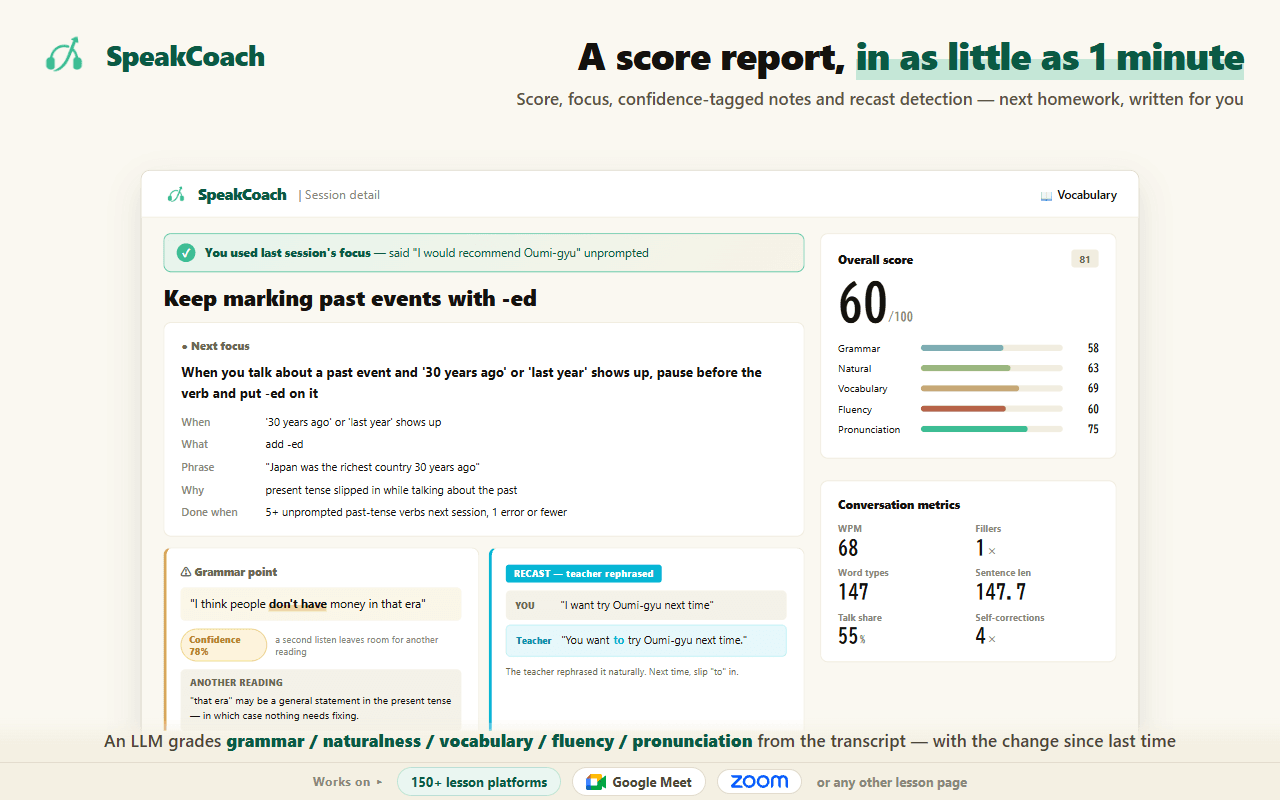
| SpeakCoach | Counts automatically how many times the same point has come up | Decides it | Recording auto-deletes after 30 days (needs the Chrome extension; desktop browser only) |
| Anki | Stays as your answer history | Decides it | Not kept |
| Notion | You add dates yourself; filters narrow it down | Does not decide | Not kept |
| Spreadsheet | You add dates yourself; sorting makes it easy to find | Does not decide | Not kept |
| Paper notebook | You add dates yourself | Does not decide | Not kept |
Source: Cambridge English / Karpicke & Roediger 2008
Choose anything other than the top two and adding the dates stays on your side. That is the part that creates the "how many times", so dropping it removes the point of choosing a tool at all. Put the other way round: paper works too, as long as you add the dates, and you still get the most important information in this article.
If you want to measure your own lessons — SpeakCoach
Summary — what to do from your next lesson
- Know the figure. B1 to B2 is 100–250 hours, or 240–600 lessons of 25 minutes. Nothing changing in six months means you are still partway.
- Self-study is not in those hours. Mix it in and you read your own position as further along than it is.
- Do not judge by the feeling of progress. Count how many times the same mistake comes up. Three in a row is a habit.
- Ask for one thing at the start of the lesson — Could you stop me when I make a mistake, and ask me to say it again myself?
- Bring back one thing you could not say, and settle on exactly one English expression for it. Do not line several up.
- Go in with three expressions to use in the next lesson. Mark afterwards whether you used them.
- Make review recall-shaped with the answer hidden, and open it the next day, three days later and a week later. Three to five minutes each time.
- Adding lessons comes last. Changing what happens around them first is not too slow.
Sources
Every source below was checked by opening the page itself. Pages change, so we note the date each one was retrieved.
Source: Cambridge English "Guided learning hours" (hours needed to reach each CEFR level) (retrieved 2026-09-04) / Mitsukaru Eikaiwa (operated by IID), one-year test article on what online English lessons achieve (in Japanese) (retrieved 2026-09-30) / Selinker (1972) Interlanguage, IRAL 10(1-4) (retrieved 2026-08-19) / Lyster & Saito (2010) Oral Feedback in Classroom SLA: A Meta-Analysis, Studies in Second Language Acquisition 32(2) (retrieved 2026-08-19) / Karpicke & Roediger (2008) The Critical Importance of Retrieval for Learning, Science 319 (retrieved 2026-08-19) / Schmidt (1990) The Role of Consciousness in Second Language Learning, Applied Linguistics 11(2) (retrieved 2026-08-19) / Nation (1989) Improving speaking fluency, System 17(3) (retrieved 2026-09-14) / Arevart & Nation (1991) Fluency Improvement in a Second Language, RELC Journal 22(1) (retrieved 2026-09-14) / Kim & Webb (2022) The Effects of Spaced Practice on Second Language Learning: A Meta-Analysis, Language Learning (retrieved 2026-08-19)
Frequently asked questions
- How long do online English lessons take to work?
- Thinking in hours rather than months is more reliable. On the figure published by Cambridge English, B1 to B2 is 100–250 hours. In 25-minute lessons that is 240–600 lessons, or eight months to one year and eight months even taking one every day (that conversion is ours). Note that self-study outside lessons and time spent around English are not inside those hours. Many articles say "three months", and they usually mean getting used to listening or feeling less resistance to speaking — a different thing from moving up a level.
- What do you get from taking an online lesson every day?
- Daily lessons show up most in lowered resistance to speaking and in phrases settling into your mouth. In hours, they accumulate more than twice as fast as three times a week. But increase only the count without changing how you take them and you simply reinforce the ways of saying things you already use. If you go daily, make one of those sessions the one where you say again what you could not say last time. That is where the effect of frequency turns into an effect on substance.
- Why do some people say online English lessons are not worth it?
- The usual reasons are that teachers change every time so weaknesses are never carried forward, that the conversation keeps going so mistakes go uncorrected, and that attending becomes the goal. All of these are about the structure, not about whether a service is good. Being understood while still being wrong is ordinary at intermediate level. The three things in this article — notice, change the correction, push slightly above — are all ways to fill that structural gap from your side.
- A year in and I still cannot speak. Does that mean it is not for me?
- Before deciding that, check two things. One is hours: three 25-minute lessons a week for a year is 65 hours, and with B1 to B2 at 100–250 hours you are not near a level’s worth. The other is substance: if you used zero new expressions in the last five lessons, the hours accumulated but what you hold did not. The first says keep going; the second says change how you take them.
- Taking a lesson every day is too much. Can I cut back?
- You can. Hours built at a frequency you keep end up larger than hours built at one you do not. When you cut back, cut lessons and keep the five minutes around them. The effect of review comes from whether it is recall-shaped and whether there is a gap, not from how often. Twice a week, with the previous page opened around those two, leaves more than daily lessons never opened.