How to Pronounce a Word | Free Ways to Check Single Words and Sentences
Published: ·Updated: ·16 min read
 Sho
ShoYou run into a word you do not know and you cannot tell how it is said. There are several places to go: a dictionary, a site collecting native speakers' recordings, a site that finds the word inside real video, the read-aloud button in a translation service. All of them are tools for checking how English is pronounced.
But which one to open is not a matter of taste. It is settled almost entirely by the kind of word. A dictionary only returns words that have been entered as headwords. Large place names are sometimes there, but people's names, company names and new product names usually are not. Conversely, when what you want to know is which part of a sentence to stress, hearing the word on its own will not answer it.
So the mapping between what you want to check and where to go comes first. After that, we’ll look at what each of the five tools actually returns, according to their official pages.
The short version. Words that are in the dictionary: Cambridge Dictionary. People, places and product names: Forvo. Stress and linking inside a sentence: YouGlish. Turning long text into audio: NaturalReader. A rough check on whether you get through: Google Translate. Between the 5, most situations are covered. And all of them give you the correct sound; none of them can tell you whether your own pronunciation matches it. That difference is what the last section is about.
Key takeaways
- Which one you open is not a preference. It is decided by the kind of word you want to check
- Words that are in the dictionary: Cambridge Dictionary. You get the transcription plus both British and American audio
- People, places and product names: Forvo. Real speakers recorded them, so words missing from dictionaries turn up
- Stress and linking inside a sentence: YouGlish. You can find the word inside real video
- Long text you want as audio: NaturalReader. You can build a model out of your own material
- A rough check on whether you get through: Google Translate is enough
- Every tool here returns the correct sound. None of them returns whether your own sound matches it
The kind of word decides where you go
Each of these tools collects its sound in a different way. A dictionary holds edited headword audio, Forvo holds recordings its users contributed, YouGlish goes and finds the sound inside video. Different collection methods mean different strengths. Here is the mapping.
| What you want to check | Where to go | What you find there |
|---|---|---|
| A word that is in the dictionary | Cambridge Dictionary | The transcription, plus both British and American audio |
| People, places, product names | Forvo | Recordings by real speakers. The same word differs from speaker to speaker |
| Stress and linking inside a sentence | YouGlish | How the word is actually pronounced inside real video |
| Long text, or your own material | NaturalReader | English you type, read aloud. You build the model yourself |
| A rough check on getting through | Google Translate | What voice input heard. It does not score |
| Whether your own sound matches | None of the above can tell you | Checking gets you the correct sound. Comparing is a separate job |
Source: Cambridge Dictionary 公式 / Forvo 公式 / YouGlish 公式 / NaturalReader 公式 / Google 翻訳 公式
The bottom row of that table is the thing most worth taking away. Everything above it tells you what the correct sound is. None of it tells you how far your own sound sits from that. Listening and comparing are two different jobs.
Dictionaries — the symbol and the sound in one place
If the word is in the dictionary, If the word is in the dictionary, looking it up there is the fastest and most reliable way to learn it. The reason is that you get the transcription as well as the audio, and once you can read the symbols, you can read the next word with the same pronunciation without looking it up. If you learn a word by ear alone, you have learned exactly one word.. The reason is that you get the transcription as well as the audio, and once you can read the symbols you can read the next word of the same shape without looking it up. Learn a word by ear alone and you have learned exactly one word.
Cambridge Dictionary plays British and American English side by side. The official site says this audio is not synthesised but recorded by real people, and that every word from CEFR A1 through C2 is covered. In other words, for anything a learner is likely to meet, assume it is in there.
One thing worth looking at while you are in the dictionary is how the pronunciation shifts with part of speech. Some words spelled identically are stressed on a different syllable as a noun and as a verb, and the dictionary lists those separately. Since a shift in stress can make a word sound like a different word, glancing at the stress mark inside the transcription while you listen pays off later.
Forvo — for the words the dictionary did not have
Somebody's name, the name of a town, a company, a product. If you use English at work, these are the ones that actually cause trouble. They are often missing from dictionaries, and they are exactly the kind of word where guessing from the spelling goes wrong.
Forvo calls itself the pronunciation dictionary on its own site, and that is what it is: a collection of native speakers' recordings of words. It does not score. Its value is that you can hear the same word from different speakers. A dictionary settles on one sound and presents it, but in practice not everyone says it that way. Play several recordings in a row and you can see what is shared and what is down to the individual.
For proper nouns, picking a recording by a speaker from that place is the safe move. Place names can be said one way locally and another way in the English-speaking world, and which one you want depends on who you are talking to. With somebody from there, leaning towards the local pronunciation lands better. In something like an international meeting, the form current in English can cause less confusion.
YouGlish — stress and linking inside a sentence
You have the word right and the sentence still does not get through. This is not unusual. In English, neighbouring sounds join together and drop out, so you can pronounce each word correctly, join them into the wrong shape, and still not be understood.
YouGlish shows you how the word is actually pronounced in real videos, rather than in a dictionary recording. You can narrow your search by part of speech, speaker gender, or a specific person, so you can see how the same word changes depending on the situation. It includes both single words and whole phrases., rather than in a dictionary recording. You can narrow by part of speech, by speaker gender and by a specific person, so you can see how the same word shifts with the situation. It takes single words and whole phrases.
The knack when using it is not to decide from the first clip. Play 3 to 5 in a row and take out what they share. Copy one person exactly and you take their habits along with the word. Extracting the common elements from several recordings makes them easier to retain.
Turning your own material into sound
Everything so far has been about finding sound that already exists. The other kind of tool turns text you supply into sound. Set phrases you use at work, or what you want to say in tomorrow's meeting, are sentences whose audio does not exist anywhere, and they belong here.
NaturalReader reads English you type and NaturalReader reads English you type and turns it into audio.. It does not score. The official site states a Free forever plan and No credit card required, and long documents and PDFs can be turned into audio as they are. It runs in the browser, as a phone app, and as a Chrome extension.
What this kind of tool returns, though, is synthesised speech. It can differ slightly from how a person would actually say it, and the gap shows most in sentences carrying emotion or emphasis. For checking set phrases it is more than enough, but keep it as your only model and your speech drifts towards the machine's.
You can start without being able to read the symbols
You look a word up, cannot read the transcription, and end up writing the sound down in the letters of your own language instead. It is a common dead end. But you do not have to learn every symbol before you start. The sounds that give you trouble are fixed, and there are usually only a handful of them.
Look at the symbols for the words you actually looked up, alongside the sound. Do that repeatedly and the frequent symbols become readable in order of frequency. Vowel symbols are numerous and hard to hold at first, so starting from the consonants and the stress mark moves faster. The stress mark is the simplest thing in the transcription to read, and it bears directly on whether you get through.
Writing an English pronunciation out in the letters of your own language is convenient as a way in, but stopping there causes trouble. A sound you learned by substituting the nearest sound your own language has stays learned as that substitute. Inside your own head it is correct, so there is nothing to notice until somebody points it out.
Should I use British or American English, and which one should I check against?
Either is fine, but deciding before you look things up is easier. A dictionary puts both in front of you, so you can listen to the two and set your own reference. Mix them and you end up saying the same word differently on different days, and you Either is fine, but deciding before you look things up is easier. A dictionary puts both in front of you, so you can listen to both and make your own choice. Mix them and you end up saying the same word differently on different days, and you lose track of which one was right..
As a rule of thumb, use the variety of English spoken by the people you speak to most. If the people you work with are American, use American English. If you deal mostly with Britain or Europe, British English. If you cannot decide, matching the side used in your coursebooks or your exam makes material easier to come by.
Either choice gets through, incidentally. Most of the people using English are not native speakers, so it is not the case that you have to commit to one side to be understood. You decide in order to stop hesitating.
Understanding it and being able to say it are not the same
Everything so far exists to get you the correct sound. Once you have it, whether you can produce it is a separate question that stays open. And these two are hard to tell apart from the inside.
In second language research, the moment a learner notices the difference between their own version and the correct one In second-language research, the moment a learner notices the difference between their own production and the correct form is seen as the first step toward acquiring that form. Put another way, a sound you hear without noticing it will not be acquired. Listening to a model and simply thinking that it makes sense will not change what your mouth produces.. Put the other way round, a sound you let pass without noticing does not go in. Playing a model and thinking that makes sense does not change what your mouth does.
(Author's summary) Only input that has been attended to becomes intake. A form the learner did not notice does not lead to acquisition, however much of it the input contains.
This is the limit of the tools for checking. They can play the correct sound, but they have no mechanism for directing your attention to the difference between that and the sound you are producing right now. To notice a difference, your own sound has to be present. Either record yourself and listen back, or use something that returns the gap.
The awkward part is a way of saying something that has already set. A word you have said the same way for years does not change just from hearing the correct version. That learners build a system of their own, different from both the target language and their first language, and that parts of it stay put however long study continues, has been argued for half a century.
(Author's summary) Forms in a learner's interlanguage can stay in place rather than being replaced by target-language forms as learning progresses. This is not exceptional; it is widespread among adult learners.
Source: Selinker (1972) Interlanguage, IRAL 10(1-4) (retrieved 2026-08-19)
And prising something loose once it has set depends on the kind of intervention. An analysis pooling classroom corrections reports that making clear what is different, and how, has a larger effect than saying the correct form back for the learner to hear. That is why playing a model is not enough on its own.
(Author's summary) Corrective feedback was more effective in the form that pushes learners to reformulate for themselves than in the form that merely supplies the correct version.
So tools for checking and tools for comparing your own sound have different jobs. The first returns the correct sound; the second returns the gap between that and yours. To fix your pronunciation you need both. The second kind is generally called a scoring tool, and it sits on a separate shelf from the checking tools.
Straight from the search box
You do not have to open any of these to hear a word. Type the word with pronunciation after it into a search box and it plays. It is faster than opening a dictionary and needs no account. For a single word, that is often all you need.
The feature that listens to you and grades you is a different matter. It is a limited beta, restricted by country and by language pair, and the pairing it runs on is practising a language other than the one you already speak. There is no pairing in which an English speaker practises English, so that side is not available to you. What is available everywhere is plain speech-to-text: say the word, read back what it typed, and you learn whether the machine heard the word you meant. That is a pass or a fail, not a score.
What to do after you have checked
Once you have the sound, saying it out loud 3 times on the spot makes it stay. Listen in silence and move on, and you will be looking the same word up again next time you meet it. Saying it aloud also sometimes catches, right there, the gap between it and the sound you had in your head.
Write down the words you checked and come back to them a few days later. Coming back briefly, many times, with gaps in between, stays with you better than setting aside one long block. 5 minutes at a time is fine.
And a sound you verified on a single word is easy to lose inside a sentence. If you can say the word but not the sentence, the cause is not the sound itself but the joining or the rhythm. When you get that far, it is time to move from tools that look up words to tools that work at the level of sentences and conversation.
You played it but still could not make it out.
You opened the right place and the sound itself is still not clear. That is usually not the tool. It is happening on the playback side. The first thing to suspect is your speakers. Built-in laptop and phone speakers are weak at the low and the high end, and fine consonant differences get flattened. Pairs like s and th, or f and th, where the difference is small to begin with, take the worst of it. ★How much any given device flattens has not been measured here, so this is not a claim that you cannot tell them apart. Switching to earphones and playing the same word again is the fastest way to separate a tool problem from a playback problem.
Speed is next. Native recordings are not slowed down for learners, so not catching it on the first pass is normal. If the tool lets you slow it down, slow it down. If it does not, repeat the same stretch. With the kind of tool that finds the word inside video, listening to the second on either side of the word shows you the sounds that are joining and disappearing.
If it still will not come, look at the transcription. Sounds your ear cannot separate are clearly different when the symbols differ. Listening again with the symbols as a handle can change what you hear. The reverse order, listening first and then reading the symbols, makes you read the symbols the way you already heard them, so looking at the symbols first is safer.
Increase the number of words you can read without looking them up you can read without looking them up
English spelling is often said to be irregular in its relationship to sound, but not all of it is. Most words can be read by rule. The more words you can read by rule, the fewer times you look things up, and the more of that time goes to the words that genuinely need it.
The endings are what pay off fastest. Words ending in -tion all read the same way; the past tense -ed settles into 3 forms according to the sound in front of it; the consonant c takes an s sound before e, i and y. There are only so many of these, so learning them removes whole groups of words from the list you have to look up.
Even so, learning the rules never takes the count to zero. The exceptions cluster in the words used most, and the shorter the word the more likely it is to be one. Words that come up daily have been in use longest and have kept older spellings. The words you assume you can read by rule are exactly the ones worth looking up once to be sure.
Pick one place to keep what you checked
Use a word once and drop it, and you will look it up again next time you meet it. In practice the words people look up twice are a fixed set, and the same ones come round repeatedly.
Pick one place. A vocabulary app, a paper notebook, a notes app; the type does not matter. What matters is not splitting it. Split it in two and you start by working out which one you wrote it in, and before long you stop writing at all.
There is a knack to what you write. Sound does not survive in letters, so writing the spelling alone will not let you reproduce it later. Write down where you tripped as well: whether you had the stress in the wrong place, whether the vowel quality was different, or whether you simply did not know the word at all. That one line tells you what to check when you come back to it.
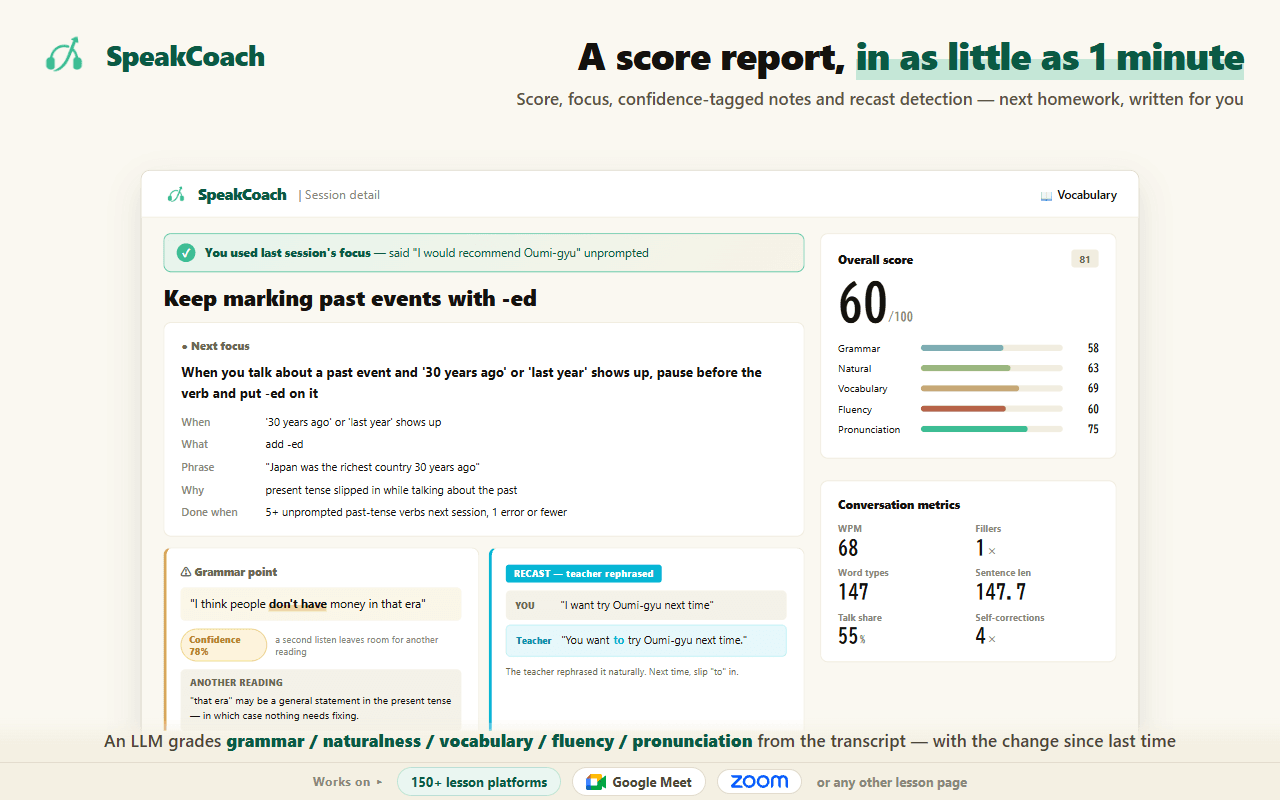
If you want this in your own lessons — SpeakCoach
Summary — which one to open, by kind of word
- A word that is in the dictionary → Cambridge Dictionary (the transcription and both British and American audio at once)
- People, places, product names → Forvo (recordings by real speakers; you can hear the same word differ between them)
- Stress and linking inside a sentence → YouGlish (finds and lines up real video)
- Long text or your own material → NaturalReader (reads English you type and makes the model)
- A rough check on getting through → Google Translate (see what voice input heard; it does not score)
- Whether your own sound matches → none of the above can tell you. That needs a separate tool, one that returns the gap
Worth remembering
- Where you look is not a preference. It is decided by the kind of word
- Words that are not in dictionaries, such as people, places and product names, will not appear however long you search a dictionary
- You do not have to learn every symbol. Look at the symbols for the words you actually looked up, alongside the sound
- Starting from the consonants and the stress mark moves faster. Stress bears directly on whether you get through
- With YouGlish, do not decide from the first clip. Play 3 to 5 and take out what they share
- Respelling in your own letters is convenient as a way in, but stop there and the substituted sound is what stays
- Decide between British and American before you look things up. Mix them and you lose track yourself
- Checking gets you the correct sound. The gap between that and your own does not come back
- A way of saying something that has set does not come loose from hearing the correct version alone
- Say a word you checked out loud 3 times on the spot, and come back to it a few days later
Sources
Every source below was checked by opening the page itself. Pages change, so we note the date each one was retrieved.
Source: Cambridge Dictionary 公式 Pronunciation (retrieved 2026-08-24) / Forvo 公式(the pronunciation dictionary) (retrieved 2026-08-24) / YouGlish 公式 (retrieved 2026-08-24) / NaturalReader 公式(AI Text to Speech) (retrieved 2026-08-24) / Google 翻訳 公式(About) (retrieved 2026-08-24) / Schmidt (1990) The Role of Consciousness in Second Language Learning, Applied Linguistics 11(2) (retrieved 2026-08-19) / Selinker (1972) Interlanguage, IRAL 10(1-4) (retrieved 2026-08-19) / Lyster & Saito (2010) Oral Feedback in Classroom SLA: A Meta-Analysis, Studies in Second Language Acquisition 32(2) (retrieved 2026-08-19)
Frequently asked questions
- The transcriptions differ slightly between dictionaries. Which one should I follow?
- Differing is normal. A transcription is not the sound itself but an agreed way of writing sound down, and dictionaries adopt different schemes. British and American dictionaries differ, and dictionaries from the same country can change between editions. In practice, settle on one dictionary and stay consistent inside it. When the symbols disagree and you are stuck, playing both sounds is faster than comparing the notation.
- Do I have to memorise the phonetic symbols?
- Not all of them. Most dictionaries carry a key to the symbols, so looking one up when it appears is enough. The few worth holding in your head are the ones for sounds your first language does not have. Knowing just those is what lets you notice, when you look a word up, that it differs from the sound you had been substituting for it. Noticing is the point; memorising the notation is not.
- What do people actually do when they meet a word they cannot pronounce?
- Look it up once, listen, say it aloud, and get all of that done in a few tens of seconds. Leaving it for later usually means never. Where you look is decided by the kind of word: an ordinary dictionary word goes to a dictionary, a person, place or product name goes to recordings by real speakers, and stress inside a sentence goes to real video. The table above is that mapping.
- Can I use these without being able to read the transcription?
- Yes. You can play the audio whether or not you can read the symbols, so starting by listening and imitating is perfectly fine. That said, if you make a habit of looking at the symbols for the words you actually looked up, alongside the sound, the frequent symbols become readable in order of frequency. You do not have to learn them all before you start. Vowels are numerous and hard to remember at first, so starting with the consonants and stress marks will help you progress faster.
- How is Forvo different from a dictionary?
- They collect sound differently. A dictionary records edited headwords with a set speaker. Forvo collects native speakers' recordings, so the same word can be heard from different people. For a word that is in the dictionary, the dictionary is faster and gives you the transcription too. The words you looked up and could not find are the ones that turn up on Forvo.
- Is the read-aloud in Google Translate not enough?
- It depends what you want it for. It works when you want a whole sentence as audio, or a rough sense of whether your pronunciation gets through. Looking at what voice input heard will tell you whether the word turned into something else entirely. But it is not scoring, so nothing comes back about what was off and where. It also does not show the transcription, so if you want to learn the symbols, a dictionary suits you better.
- Why do different people pronounce the same word differently?
- Both regional and individual variation. British and American English treat certain vowels and endings differently, and inside one region it shifts with generation and speaking speed. When several recordings sound different from each other, it is closer to the truth to assume both exist than to assume one of them is wrong. What matters is what they share, because that is the part that does not move.
- Will checking on its own fix my pronunciation?
- It gets you as far as knowing the correct sound, but not to knowing whether your own sound matches it. Words you have said the same way for years in particular are known not to come back from hearing the correct version alone. A separate step is needed: record yourself and listen back, or It helps you learn the correct sound, but it does not tell you whether your own pronunciation matches it. In particular, words you have pronounced the same way for years are unlikely to change simply from hearing the correct version. You need a separate step: record yourself and listen back, or use a tool that shows you the difference, so you can see where your pronunciation is off., so that where you are off becomes visible.
- Should I look a word up in the middle of a lesson or a meeting?
- It is better not to do so during a lesson. While you are looking, the other person's speech stops going in, so you lose everything around that one word for the sake of it. Even if you do not know the spelling, a note of the sound as you heard it is enough to find it afterwards. Looking things up in a batch at the end usually nets you more words. The exception is a word you have to say back on the spot, like somebody's name or a place name. There, asking the person how it is said is faster and more reliable than looking it up.
- Is it all right to rely on a pronunciation respelled in the letters of my own language?
- As a way in, it is convenient. It gets you closer than having no handle at all. Just do not stop there. When you substitute the nearest sound your own language has for a sound English has and yours does not, the substitute is what settles in as the sound of the word. Inside your own head it is correct, so there is nothing to doubt until somebody points it out. Once the respelling has got you into the area, always listen to the sound itself and write over it.
- How do I check how an English word is pronounced?
- Where you go changes with the kind of word. Dictionary words go to a dictionary; people, places and product names go to recordings by real speakers; how something is said inside a sentence goes to a tool that finds it in video. The table above sets out the mapping.
- Is what is free enough on its own?
- For checking the sound of one word, yes. Dictionary audio and transcription, recordings by real speakers, and examples of use inside video are all available at no cost. What costs money starts at the point where you want your own pronunciation scored. For looking things up, free covers it.
- Can I do this in an app as well?
- Yes. Dictionary apps carry the transcription and the audio, so you do not have to open a computer. But it is still one word at a time, and there is nothing you can do that you could not do on the site. For checking on the move, an app. For comparing several speakers, For checking on the move, use an app. For comparing several speakers, the site is better..
- Where do I look to find which syllable is stressed?
- There is a mark inside the transcription. The small vertical line in front of a syllable is the signal to press on that syllable, and every dictionary includes it. Respelling in the letters of your own language loses the strong and weak contrast, so check the position with the symbols at least. Some words shift the position between noun and verb, so it is safest to look at the transcription for each part of speech.
- What English word would you recommend?
- Check the transcription and the audio in a dictionary first, and if it still does not settle, listen to recordings by real speakers. A dictionary gives you one cleanly recorded sound; speaker recordings give you several ways the same word is said. If both sound the same to you, you can take that sound and keep it.